Understanding color is really breeder-vetting in disguise — and that’s what this guide is built to give you. Ragdoll cats have 6 recognized point colors, like seal, chocolate, blue, red, cream, and lilac, layered over a handful of patterns and a couple of modifiers. Every dazzling variation you’ve seen in a listing is built from that one small framework, and once you can see the framework, you can read a kitten’s coat like a label.
Every purebred Ragdoll is pointed; color settles on the ears, face, legs, and tail while the body stays pale. That is why a truly solid black Ragdoll doesn’t exist. This matters more than it first appears. Knowing that a “rare black Ragdoll” is almost always a very dark seal point is exactly the kind of knowledge that protects your deposit.
Every Ragdoll Color and Pattern, in One Simple Framework
It seems like there are countless Ragdoll variations. In reality, behind all of this lies a single small set of genes in various combinations, and you can figure it all out in a couple of minutes. The color always appears on the ears, face, paws, and tail, while the body remains lighter. There are six such colors: seal, blue, chocolate, lilac, red (“flame”), and cream. The CFA standard allows any of these in any pattern.
The pattern refers to the white: how much of it there is and where it appears. Colorpoint has no white at all. “Mitted” features white “gloves” on the paws and a white chin. “Bicolor” has an inverted white V-shape on the face. “Van”—color remains only on the head and tail; the rest of the cat is white. On top of this, there can be two additional “patterns”: “Lynx” adds tabby stripes, and “Tortie” features a mottled play of colors. These can appear on any color and any pattern. Behind all this are dozens of names that even sellers often get confused about. Once you figure it out, you’ll be able to read any ad like an open book.
Why Ragdolls Are Born White: The Genetics of Pointed Coats
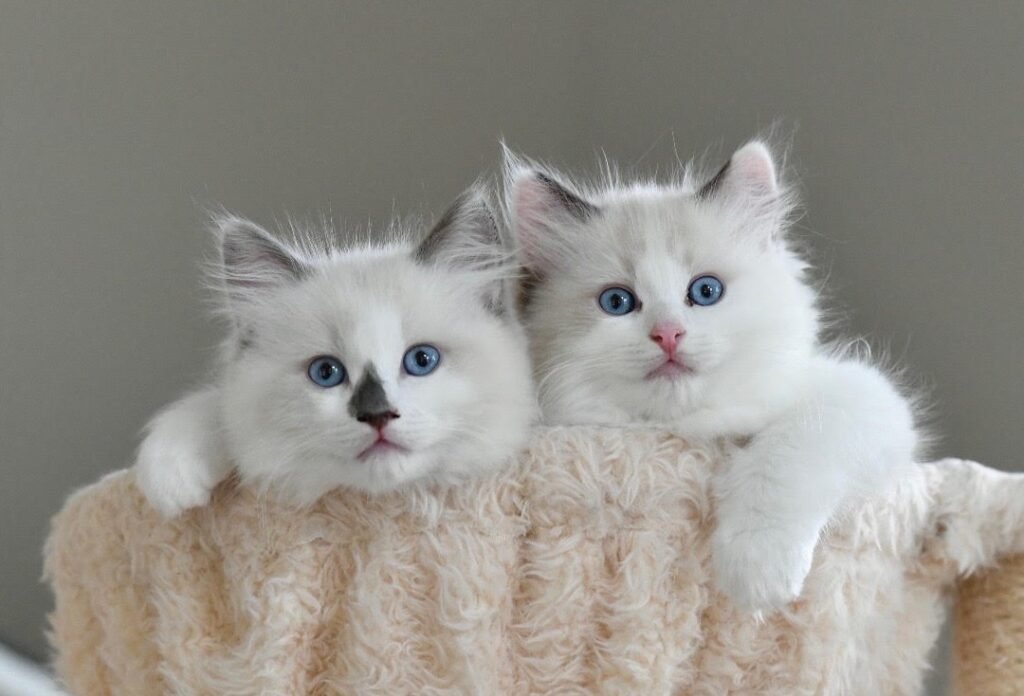
Every Ragdoll kitten is born white (not cream, not pale — white). The color arrives later, and one gene is responsible.
That gene is TYR, which produces tyrosinase — the enzyme that builds pigment. Ragdolls carry a temperature-sensitive version of it, the same colorpoint variant found in Siamese cats. The enzyme works well in cooler skin and barely works where the body runs warm.
That single quirk explains the whole look. A cat’s torso is its warmest region, so it stays pale. The ears, mask, legs, and tail run a few degrees cooler, so pigment develops there and deepens over the first couple of years. The gene decides where color lands, not which color it is.
Picture a seal point kitten at three weeks: near-white, with only a faint smudge on the ears. By twelve weeks, the mask and tail are unmistakable, and the coat keeps darkening well into adulthood. A kitten that looks washed out at eight weeks isn’t poorly colored — its color is simply still arriving.
The Six Ragdoll Point Colors
Six colors may be a lot to keep in mind when thinking about Ragdoll cats. It may take a while to see the logic behind it. Every classic Ragdoll color starts with just two pigments: one black-based and one red-based. A separate dilute gene then softens whichever pigment is present, turning dense color into a paler version of itself. That’s the whole palette.
A black-based pigment gives you a seal, and its dilute is blue. Add the recessive chocolate gene and that same black-based pigment lightens to chocolate, whose dilute is lilac. Red-based pigment gives you red (flame), and its dilute is cream. Three dense-to-dilute pairs, and you have all six:
seal → blue chocolate → lilac red → cream
One practical tip you’ll use at pickup: coat color shifts with season and age, so experienced breeders confirm color by the nose leather and paw pads instead — slate gray for blue, lavender-pink for lilac, coral for flame. A kitten whose points look ambiguous in photos usually gives itself away the moment you see those pads in person.
Chocolate and lilac tend to cost more for one simple reason: both need a recessive gene from each parent, which makes them harder to produce — not better cats.
Seal Point — The Classic Ragdoll
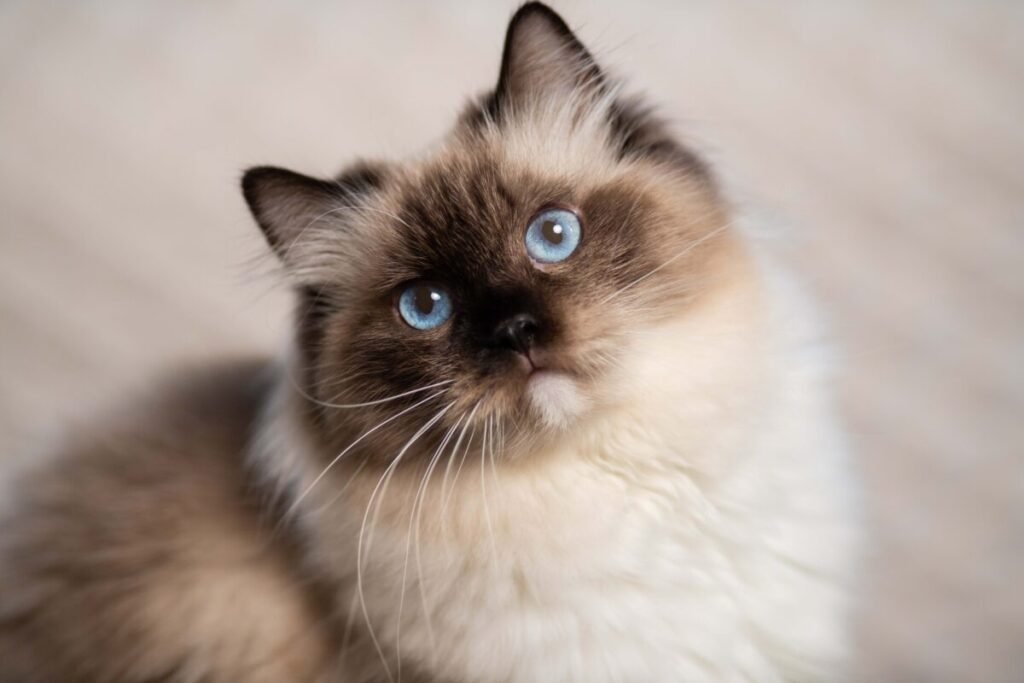
Seal is the darkest of the six primary coat colors and is exactly what most people picture when they hear the word “Ragdoll.” The points—the mask, ears, paws, and tail—have a deep brownish-black hue that contrasts sharply with the warm cream or fawn-colored body.
This is where buyers may often be wrong. When seeing an adult seal cat in dim light, it’s easy to focus on the dark mask and assume the cat is entirely brown. In reality, this pigment is found only on the extremities. The nose and paw pads provide the definitive answer: if they are a warm brown shade, you’re looking at a true, and yes, a “seal” kitten continues to darken with age, and the contrast between the body and the points deepens until about two years of age.
Blue Point
Blue is essentially the same as seal, but softened by the dilute gene: the rich brown-black lightens to a slate-gray hue. Add the dilute gene, and the deep brown-black softens to slate gray. This is blue: a cool, steel-gray tone on the points, while the body appears more white or icy pale than warm cream. Blue looks cooler than seal—and this is the quickest way to tell them apart in a photo. If you’re unsure, the paw pads will be the deciding factor: in a true blue, they are a dark slate-gray shade and are never brown. The contrast between the body and the points in a blue is usually slightly softer than in a seal.
Chocolate Point
Chocolate is a warmer, lighter relative of the seal coat color: more milk chocolate than dark. The points have a soft brown hue that never approaches black, while the body remains ivory-colored.
You won’t often find these kittens in a litter—and the reason is purely genetic. The chocolate coat color is recessive, so both parents must carry it. Two seals will produce a chocolate kitten only if each is a hidden carrier of this gene. The nose is the definitive indicator of the coat color: in a chocolate cat, it is cinnamon-pink, not brown. So if a breeder calls a kitten “chocolate” but its paw pads have a warm silvery-brown tint, that’s a reason to ask questions.
Lilac Point
Lilac is the palest color in the breed — a frosty pinkish-gray that can look almost like fog on the points, over a glacial white body. It’s the dilute of chocolate, so a kitten needs the recessive chocolate gene and the dilute gene from both parents, which is exactly why lilacs stay uncommon. Identification is easier than it sounds: lavender-pink paw pads and nose leather confirm it, while any slate or blue tone means you’re actually looking at a blue point. Lilac develops slowly, sometimes taking well over a year to reach its full (still delicate) color.
Red Point
Red or “flame,” which most breeders call it, plays by different rules. The orange pigment is encoded by its own gene and completely overpowers the mechanism responsible for black-brown coloration. So “flame” isn’t a lightened or altered “seal,” but a distinct pigment in its own right. As a result, the points on the paws and ears take on a warm orange-ginger hue against a cream-white body, while the nose and paw pads are coral-pink. Another distinctive feature: “flame” cats often have barely noticeable stripes, even if they are not of the “lynx” variety. Typically, the orange pigment is unevenly distributed, so faint “ghostly” stripes are almost always present.
Cream Point
Cream is essentially the same as “flame,” only muted. The dilute gene softens the orange to a delicate apricot-beige, so the points appear more peachy than red against the nearly white body. This is the most delicate coat color in the breed—and that’s exactly why it’s most often misidentified. A closer look at the nose and paw pads will provide certainty: in a true “cream,” they are pinkish-beige, not coral. But color is only half the picture: a completely different gene determines exactly where the white appears on the body.
The Four Ragdoll Patterns: Where the White Falls
The amount of white on a Ragdoll ranges from none at all to nearly half the body, depending on the pattern.
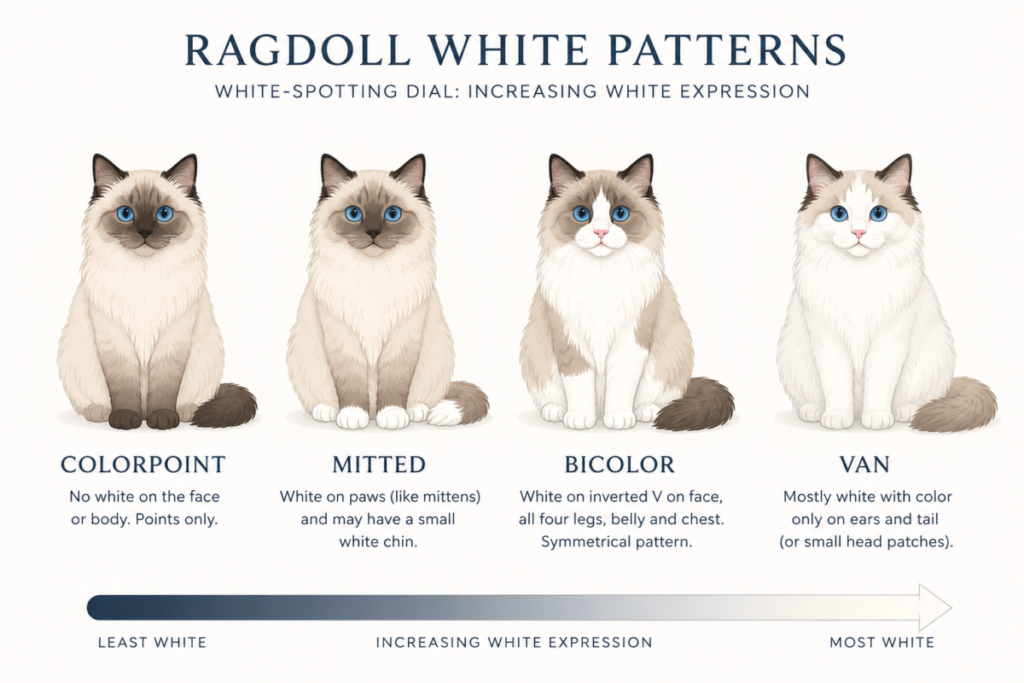
That gene is KIT — written as S, and called white spotting. It limits how many pigment cells reach certain areas during the kitten’s development, so the white isn’t a color at all; it’s the absence of color. The underlying point color stays the same beneath it.
Turn the dial to zero, and you get a colorpoint with no white anywhere. A low setting produces the mitted pattern: white chin, front mittens, back boots, often a belly stripe. A medium setting gives bicolor — the inverted white V on the face, with white legs and belly and noticeably more coverage than a mitted. Push it to the top, and you reach van, where color survives only on the head and tail.
One thing breeders watch closely: two mitted parents can produce a high mitted kitten that looks bicolor to the eye but isn’t, genetically — a distinction spelled out in the GCCF Ragdoll breeding policy. It rarely matters for a pet home, but it tells you whether a breeder truly knows their lines.
Colorpoint — No White at All
A colorpoint carries no white-spotting gene, so the point color runs solid and unbroken across the mask, ears, legs, and tail. No mittens, no belly stripe or anything else, just clean contrast against a pale body. It’s the closest the breed comes to a pure expression of the pointed pattern. Some buyers find it the most striking look of all, precisely because nothing distracts from the color itself.
Mitted
Mitted is the low setting on the white-spotting dial: white mittens on the front paws, longer white boots up the back legs, a white chin, and often a white stripe down the belly. Everything else keeps its full point color. Some mitted kittens also carry a blaze — a white flash down the nose — while a littermate has none. Our seal-mitted queen Melda is a good example of the pattern executed cleanly: full seal points, crisp white on the chin and paws, and the poise to match. When the chin isn’t white, a kitten is technically mismarked for show — though your cat won’t mind in the slightest.
Bicolor
Turn the dial to medium, and the white takes over the cat’s front. A bicolor shows a clean inverted white V across the face, white legs, and a white belly, with color left on the ears, mask edges, and tail. The nose leather is pink. It’s the pattern pet families ask for most often — a seal bicolor reads almost like a masked cat from across the room, which is the look filling most Ragdoll feeds on Instagram. For show, the V should be symmetrical; for your living room, it makes no difference at all.
Van
Van sits at the far end of the dial. Color survives only on the ears, the mask above the eyes, and the tail, sometimes a stray patch on the body, while everything else stays pure white. It’s the rarest of the classic patterns, and it appears unpredictably even in catteries that produce plenty of bicolors. A seal van can look nearly white in a photo until you spot the dark tail. Waitlists for van kittens tend to run long.
Lynx and Tortie: The Modifiers That Multiply the Looks
Neither of these is a color. Both are overlays that sit on top of whatever base color and pattern a kitten already has.
The lynx overlay comes from the dominant agouti gene, which bands each hair rather than coloring it solid. The result is faint striping on the legs and tail, an M-shaped marking on the forehead, and pale liner around the eyes. Because the pointed gene keeps pigment on the cooler extremities, the striping shows only on the points. Our queen Eve — a seal bicolor lynx — wears exactly this: a pale body, a crisp white V, and delicate tabby striping through her mask and tail.
The tortie overlay works differently. It comes from the X-linked orange gene, so patches of red or cream mottle through the base color rather than sitting in tidy blocks. Because it takes two X chromosomes to display both pigments, tortie Ragdolls are almost always female. Carry both overlays at once, and you get a tortie-lynx, usually shortened to torbie — mottling and striping together.
That’s why the online list of names feels endless. Six colors, four patterns, two overlays that stack in any combination — multiply them and the descriptions pile up fast, even though the genetics underneath stay simple.
Is There Such a Thing as a Solid Black Ragdoll?
The short answer is no. The pointed gene every purebred Ragdoll carries prevents full-body pigmentation, so solid black is entirely outside the traditional Ragdoll colors.
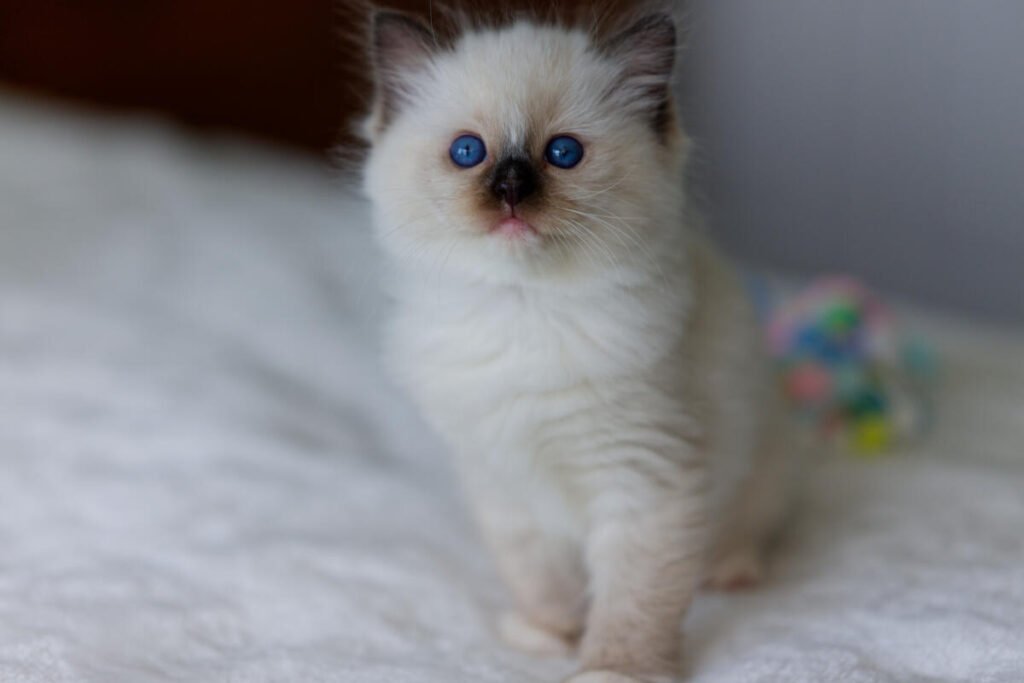
What people are usually seeing is one of three things. Most often it’s a very dark seal point mistaken for black — a mature seal can look nearly black on the mask and tail in low light while its body still reads warm cream. Sometimes it’s a mismarked Ragdoll, where excess dark areas blur the point contrast without erasing it. And sometimes it’s a Ragdoll mix or a non-purebred cat with some Ragdoll ancestry and no pointing at all.
There’s one more wrinkle worth noting: TICA’s Cherubim reclassification moved mink, sepia, and solid-colored cats of this type into a separate breed group rather than into the pointed Ragdoll standard, as outlined in TICA’s Ragdoll standard proposal. If a seller advertises a black Ragdoll at purebred pricing, ask for pedigree paperwork before you send a deposit. A genuine listing should never come with a “rare black” premium.
The Rarest Ragdoll Colors — and What Blue Eyes Really Mean
There are two rare color patterns in the Ragdoll breed: Lilac and Van. The reason is the same in both cases: for these patterns to occur, several recessive genes must coincide. Lilac: for a kitten to be lilac, it must inherit the “chocolate” genes from both parents, as well as the dilution genes.
These are four separate genetic factors, and they all have to align correctly. Van, the rarest of the classic patterns, follows the same logic: such a high proportion of white is extremely rare. Now combine these factors—and the rarity increases exponentially. A lilac tortoiseshell cat or a lilac bicolor with a marbled pattern, featuring both spots and stripes, is perhaps the rarest thing you’ll ever see in this breed.
The key point is that every traditional Ragdoll has blue eyes: the same “colorpoint” gene that limits coat pigmentation also limits eye pigmentation. The shade can vary—from pale blue to deep sapphire—but that’s the entire range, period. If a kitten’s eyes appear green or golden—ask why. An unusual eye color usually indicates a mink, sepia, or mixed-lineage Ragdoll rather than a true colorpoint Ragdoll. And you have the right to hear an honest answer before you make a down payment.
Ragdoll Color and Pattern Chart
Once you know what to look for in words, it helps to see the combinations laid out. This quick reference reads two ways: confirm color from the paw pads, confirm pattern from the face and feet.
Feature |
Colorpoint |
Mitted |
Bicolor |
| Face white | None | White chin only | Inverted white V |
| Front paws | Full point color | White mittens | White legs |
| Nose leather | Matches point color | Matches point color | Pink |
| Typical white | Zero | Chin, paws, belly stripe | Face, legs, belly |
| Lynx overlay | Striped points | Striped points and boots | Striped ears and tail |
A name like “seal lynx mitted” simply stacks all three: the color (seal), the overlay (lynx), and the pattern (mitted). Charts do flatten the rarer colors, though, so when a coat looks borderline, trust daylight photos over any grid — a bicolor is obvious outdoors and can look odd under a lamp.
Does Color Change a Ragdoll’s Personality or Price?
A cat’s coat color says nothing about its personality. Recent studies of domestic cats have consistently failed to find a link between color and personality; stories about “mean ginger cats” or “gentle gray cats” reflect our expectations rather than the cat’s actual personality. The Ragdoll’s signature gentleness is the result of decades of selective breeding and the care with which kittens are raised during their first 12 weeks of life. A bicolor “seal” and a lilac “colorpoint” from the same litter will both melt in your arms.
But the price—that’s a different story. It’s determined by rarity, pedigree, and titles, not by what kind of companion the cat will grow up to be. Lilac and “van” cats cost more because their genetics are harder to combine, and kittens from titled parents have a documented lineage. “Bicolor” and “mitted” cats are often more expensive than “colorpoint” cats—simply because they’re in higher demand. But none of these extra features make a cat any better. More important than color are medical tests and a written guarantee from a registered breeder. And if you’re asked to pay extra for a “black Ragdoll”—that’s a reason to be wary, not to pay the extra fee: that coat color simply doesn’t exist in the breed.
How to Confirm a Kitten’s Color and Health Before You Commit
Four things, in this order, before any money changes hands.
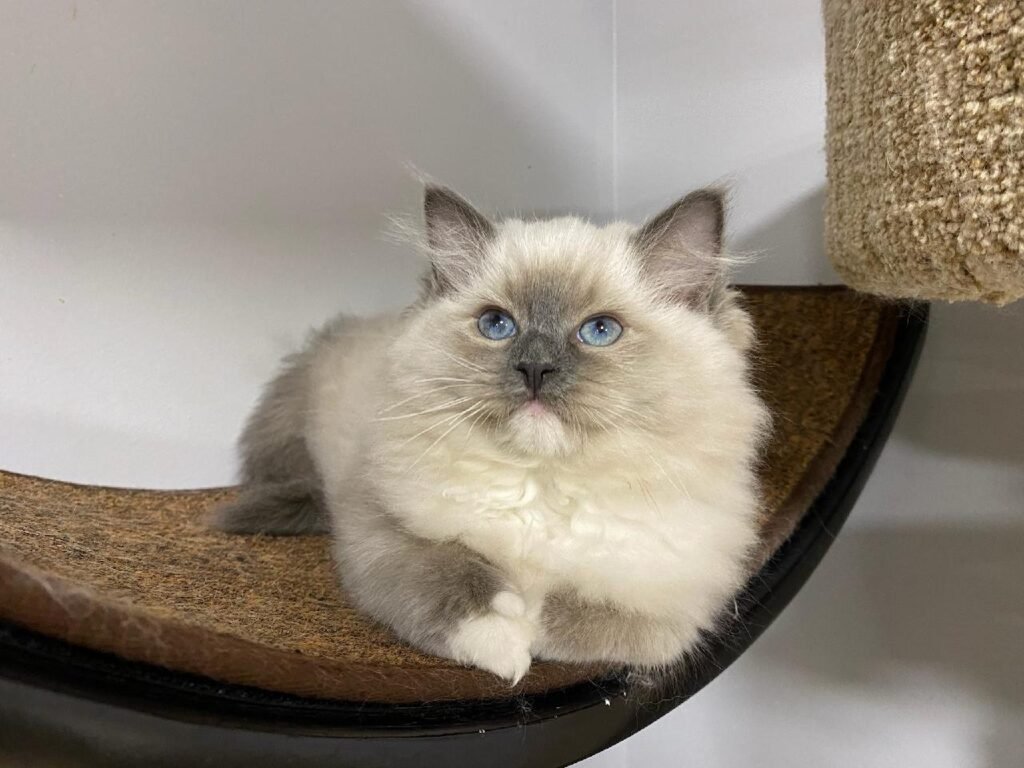
First, see the kitten for yourself. A live look — in person or in real time — shows you the kitten moving, the room it’s raised in, and its true coat color in natural light. Recorded clips and filtered photos hide too much; insist on seeing the real thing.
Second, ask for parent photos and pedigree verification. The sire and dam tell you what your kitten will likely become, since a lilac carrier looks nothing like her seal-point sister. Pedigree paperwork should list registration numbers and cattery names for cross-checking, and TICA cattery registration can be confirmed with one phone call.
Third, ask for FeLV/FIV testing for both parents and the kitten, with results documented by a licensed veterinarian. Fourth, get a written health guarantee — the terms should be on paper, not in a text message. Every one of our kittens is tested for FeLV and FIV and goes home with that guarantee in writing.
None of these four is optional once you’ve seen a scam listing built from stolen photos.
Want to see these colors in real life?
Follow @jerseyragdolluxe on Instagram and TikTok to watch our kittens grow up in real time, or email us to ask about our current litters.
What Fifteen Years With These Cats Has Taught Us
After 15 years of breeding Ragdolls, we’ve seen how people fell in love with the cats’ color and eyes online, and then fell even more in love with the kittens themselves, who would run out to greet them when they came to see them. People come hoping to take home a blue bicolor, but they return home with a “rustic” female with “gloves,” and even years later, they continue to send us photos and messages of happiness.
Sometimes there are disappointments, such as when the cat’s screening process is ignored. The hardest calls we receive are from people who transferred a deposit based solely on photos, never asked about FeLV/FIV test results, and never received a guarantee. A rare coat color is evidence of genuine breeding efforts and a deep pedigree, but it doesn’t in itself make a cat a good or bad companion. So focus on what matters: ask to see the kitten in person, read the guarantee carefully line by line, and verify the cattery’s registration. Then choose the kitten you can’t take your eyes off—and that can’t take its eyes off you—and you’ll definitely make the right choice.
Choosing Your Ragdoll with Confidence
6 colors — 4 patterns — 2 pads.
That’s the whole system—and now you’ll be able to decipher any ad that catches your eye. Check the color by looking at the paw pads and nose, and the pattern by looking at the muzzle and paws. And always ask for photos taken in natural light, without filters: “cream” can easily look almost white under a warm light. Then set the question of color aside. Because the next fifteen years won’t be determined by coat color, but by something else entirely—the results of health tests, temperament, and how much love the kitten received even before it crossed the threshold of your home.
So which color should you choose? Honestly, the one whose face you keep scrolling back to. Meet ours. Follow @jerseyragdolluxe on Instagram, TikTok, and YouTube to see our Ragdolls in motion, or reach out by email with your questions about color, pattern, and paperwork — we’re always happy to talk Ragdolls.
Frequently Asked Questions
What is the rarest Ragdoll color?
Lilac point. It needs the recessive chocolate gene plus the dilute gene from both parents, so it appears far less often than seal or blue. Rarer still are combinations like lilac tortie or lilac torbie bicolor.
What colors do purebred Ragdolls come in?
Six point colors: seal, blue, chocolate, lilac, red, and cream. Each can appear as colorpoint, mitted, bicolor, or van, and any of those can carry a lynx or tortie overlay.
Can a Ragdoll be solid black?
The breed standard requires pointed coloring, so a purebred Ragdoll is never solid black. A “black Ragdoll” is usually a very dark seal point, a mismark, or a mixed-breed cat — ask for pedigree paperwork.
Do Ragdoll kittens change color as they grow?
Every Ragdoll is born white and develops its points over the following weeks, with the coat continuing to darken for about two years. A pale eight-week-old kitten is completely normal.
Do all Ragdolls have blue eyes?
The same colorpoint gene that limits coat pigment also limits eye pigment, so every traditional Ragdoll has blue eyes, from pale sky to deep sapphire. Green or gold eyes point to mink, sepia, or mixed ancestry.
Why are some Ragdoll colors more expensive?
Price follows rarity, lineage, and titles rather than quality. Lilac and van are harder to produce genetically, and kittens from titled parents carry documented pedigrees — but a pricier kitten isn’t a better companion.
How can I tell what color my Ragdoll kitten is?
Check the nose leather and paw pads rather than the coat, which shifts with age and light: slate gray means blue, lavender-pink means lilac, coral means flame, and warm seal-brown means seal.

Check to see if we have adorable Ragdoll Kittens available!
See TICA for more information about the Ragdoll Cat